

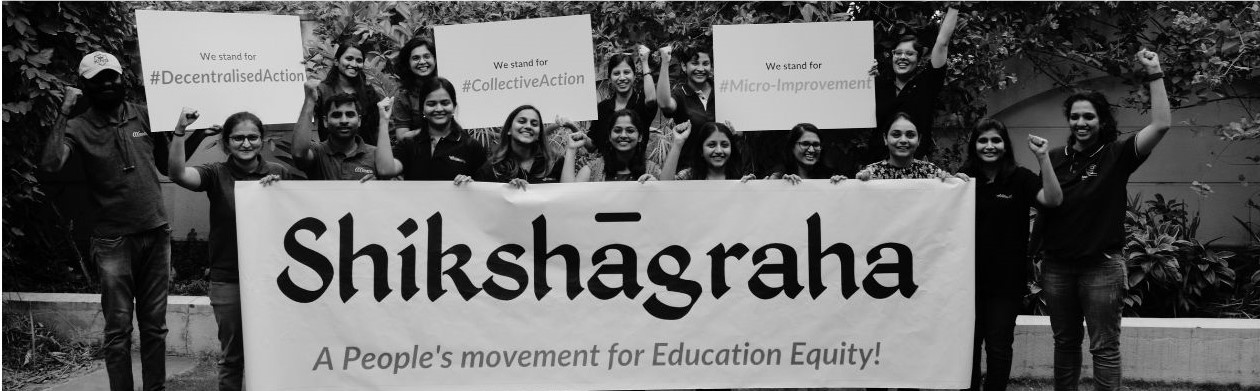
Shikshāgraha is a people’s movement that enables the education leaders, District Institutes of Education and Training (DIET) & Civil Society Organisations to lead the co-creation efforts for the need-based programs. Our mission is to Energise need-based school improvement programs in 100 districts, impacting 40 million children by 2025, collectively!
The idea of building a people’s movement towards Education Equity, an EduMentum initiative, ‘Shikshāgraha’ was born to solve India’s education inequity by empowering local communities to reach a larger impact and scale.
India’s education inequity remains a significant challenge, given the vast scale of our educational system, with 250 million children attending 1.5 million schools. It is our collective responsibility to ensure that every child in India receives the precious gift of quality education, and hence, Shikshāgraha was ideated.
Driven by inspiration from India’s largest Movement, Satyagraha, Shikshāgraha is a portmanteau of two Sanskrit words, Shiksha, which means knowledge, and Agraha which means with great enthusiasm.
Satyagraha draws its inspiration from the ancient Indian ideal of ahimsa (’non-violence’) and collectively forms a powerful philosophy of resistance and social change, emphasising the importance of truth, dialogue, and empowerment in the pursuit of a better society.
The dialogue..
In today’s diverse classrooms, dialogue among stakeholders is essential. Teachers, students, parents, and policymakers must collaborate to shape education. The principle of dialogue encourages these diverse voices to come together, fostering an equitable educational ecosystem.
Collective action emphasises the power of unity and solidarity among individuals who share common goals. This is a fundamental aspect of Satyagraha, and Shikshāgraha where people join together in a shared commitment to narrative building.
Why Shikshāgraha?
Shikshāgraha empowers students, parents, and teachers to advocate for better education by providing them with the tools and knowledge needed to effect change through Micro-improvement and Decentralised action.
Collectively, we can engage authorities and policymakers in conversations about the issues at hand. In line with NCERT’s philosophy of Nipun Bharat, the core principle of Shikshāgraha is decentralised action facilitated by district empowerment. Shikshāgraha aims to empower districts by giving them the autonomy to conceive and execute programs customised to their distinct requirements.

Why empower the ‘districts’?
Satyagraha’s principles respect the autonomy of individuals and communities to determine their own destinies.
Similarly, Decentralised action promotes local autonomy and decision-making. It encourages communities or local authorities to take charge of their own development and make decisions based on their unique needs and circumstances. Both concepts aim to bring about social change. Satyagraha challenges oppressive systems or practices to create a more just society. Shikshāgraha focuses on local and district-level problems, aiming to enhance conditions at the fundamental level. This contributes to wider societal improvements and positive change.

As a movement, it will enable..
- ‘Districts’ as the unit of change,
- Collaboration between ‘district education department’ and local CSOs,
- Decentralised action by promoting Micro-Improvements based initiatives that are powered by platforms like DIKSHA.