
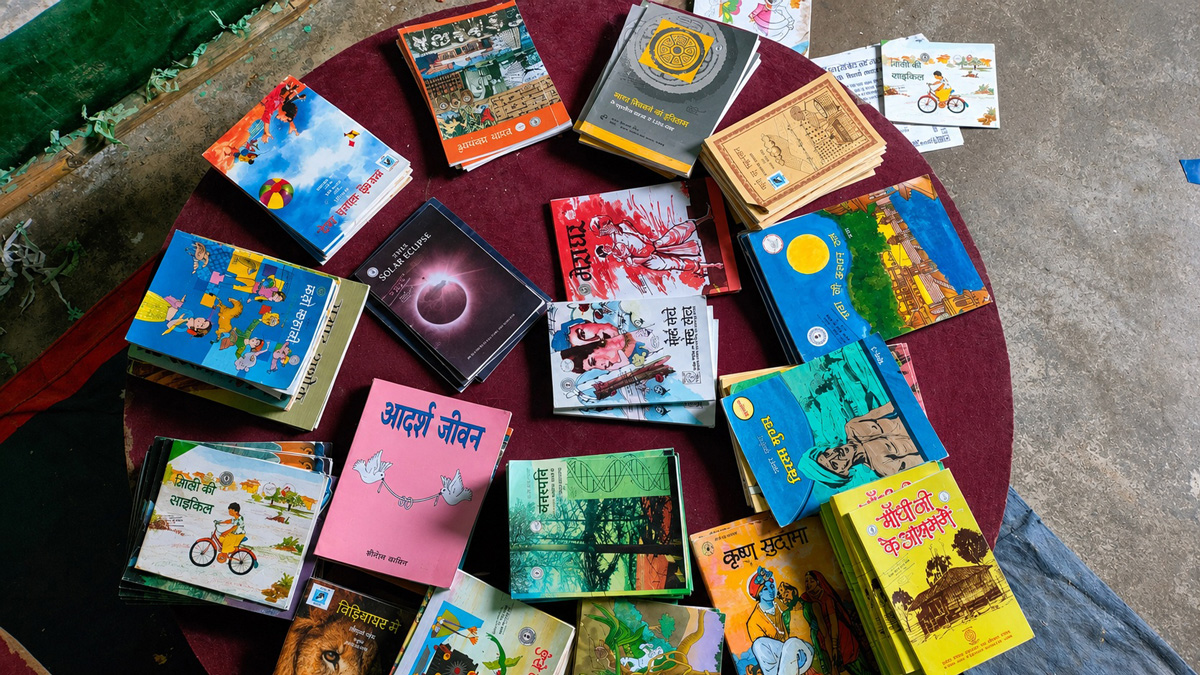
Over two days in Sahibganj district [northeastern Jharkhand], I visited one school after another, each one revealing something I hadn’t quite expected. In one, a library occupied a whole room. In another, it was tucked into the office-cum-staff room. In many, books lined the walls of the very classrooms where students sat for lessons.
But what struck me wasn’t just that these libraries existed in schools. It was the evidence, everywhere I looked, that students were actually using them. Books showed signs of being read. Registers tracked recent borrowing, renewals and returns. Children spoke excitedly about stories they’d read. Something real [learning] was happening here.
The story of how it came to be began to emerge as I listened to teachers, watched communities in action, and pieced together the different threads that had woven this meaningful experience for children.
A Teacher’s Vision in Taljhari
At Government Primary School Banskola Santhali in Taljhari, Head Teacher Sanjeev Kumar Mandal walked me through the newly constructed building. Four classrooms, an office, and a kitchen-cum-store room. But also, he’s the only teacher. So only two classrooms are actually used for teaching – Grades 1 and 2 in one, Grades 3 to 5 in another. He switches between them throughout the day, managing a multigrade setting that has become the norm in this district, where over half the schools have just one teacher.
“So what about the other rooms?” I asked.
He smiled and led me to one of them. Books displayed around the walls, monthly student magazines stacked in cupboards, teaching-learning materials organised neatly – a library.
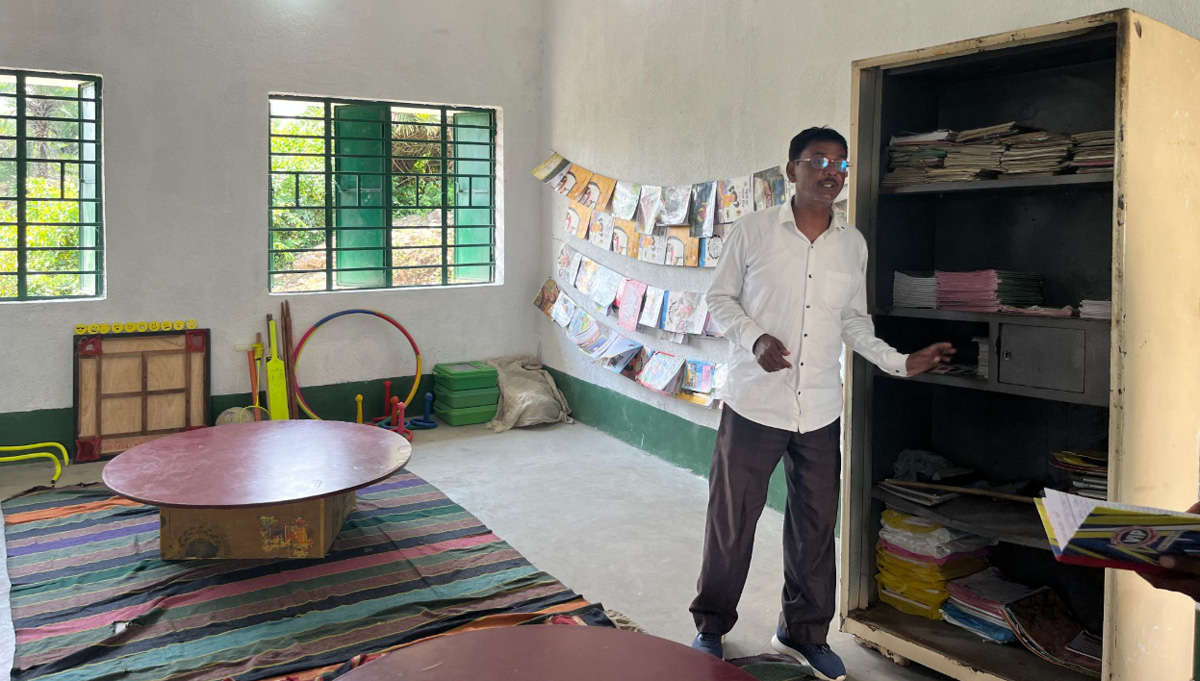
Sanjeev’s face lit up as he described how his students love the space. They’ve developed a routine: towards the end of the week, students visit the library and pick a book or magazine to take home for the weekend. On Monday, they come back and share the stories they have read with their classmates.
He eagerly showed me the register he maintains, tracking every book issued. “The library has helped build a culture of reading,” he said. “The children’s habit of reading at home is indirectly leading to learning at home.” He pointed to the visible improvement in reading skills over the past few months, since the library space and reading routine were established.
Standing in that classroom-turned-library, watching Sanjeev flip through his carefully maintained register, I found myself wondering: how did this happen? Not just here, but across so many schools in the district?
Layers of Support
The answer, I discovered, lay in how different people at different levels had chosen to act.
The district administration had launched an initiative to ensure all schools set up active library spaces. They shared a guideline document with schools – not a rigid prescription, but a framework. Block-level training on Foundational Literacy, oriented teachers on strategies to make libraries vibrant spaces for learning. Schools were given this as a time-bound task, with plans for follow-up projects to support teachers in enhancing student literacy outcomes.
But guidelines alone don’t transform classrooms, do they?
Cluster Resource Persons (CRPs) supported teachers hands-on in setting up libraries. Block Resource Persons (BRPs) organised meetings to review implementation, but these became more than just monitoring exercises. CRPs shared field observations, best practices, and challenges. The groups reflected and learned from each other. The District Education Officer conducted regular reviews with BRPs and the Prajayatna team, one of the movement builders, maintaining oversight while allowing space for adaptation.
Each level in the system played its part. Each enabled the next.
The Day a Library Came Alive
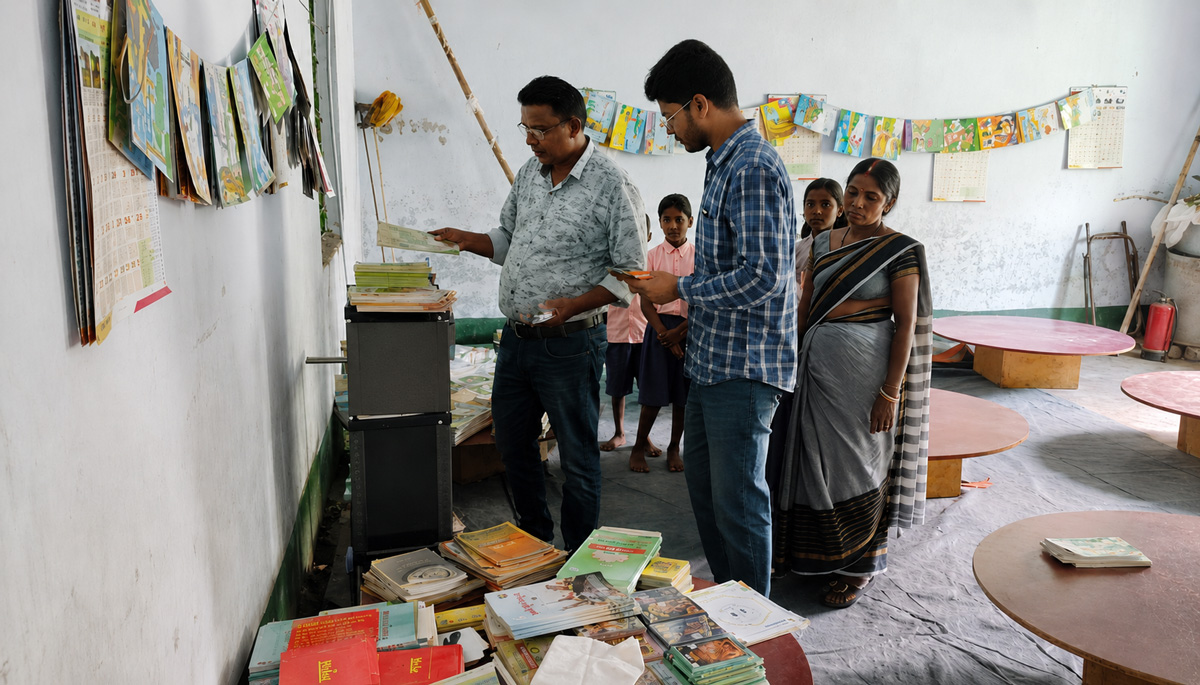
But the story that really stayed with me came from PS Jhagru Chowki in Sahibganj. I heard it from one of Prajayatna’s team members, Ankit Aman, who is also a contributor to this blog and witnessed it unfold.
The school had no functional library. About 550 books were stored somewhere, unused. On 14 September 2025, during a School Management Committee meeting, the members, teachers, and parents gathered to discuss how the library could be revived. The challenge was immediate and practical: the school had only two classrooms, both of whose roofs/ walls leaked during the rain. So where would they safely keep the books?
The Headmistress didn’t hesitate. When someone mentioned the school had no bookshelves, she promised to arrange them. And just like that, the SMC members contributed funds to buy additional shelves. Within days, the racks arrived.
What happened next was something you don’t often see documented in education reports.
After the meeting, the entire school community – teachers, students, SMC members – came together with what the team member described as “great excitement and energy.” They opened the old almirah that had been closed for years. Books that had been lying unread for so long were brought out one by one. Students eagerly helped clean them, turning dusty pages into treasures again. With the new book racks in place, everyone began organising carefully. Storybooks for Grades 4 and 5. Colourful pictorial books for Grades 1 to 3.
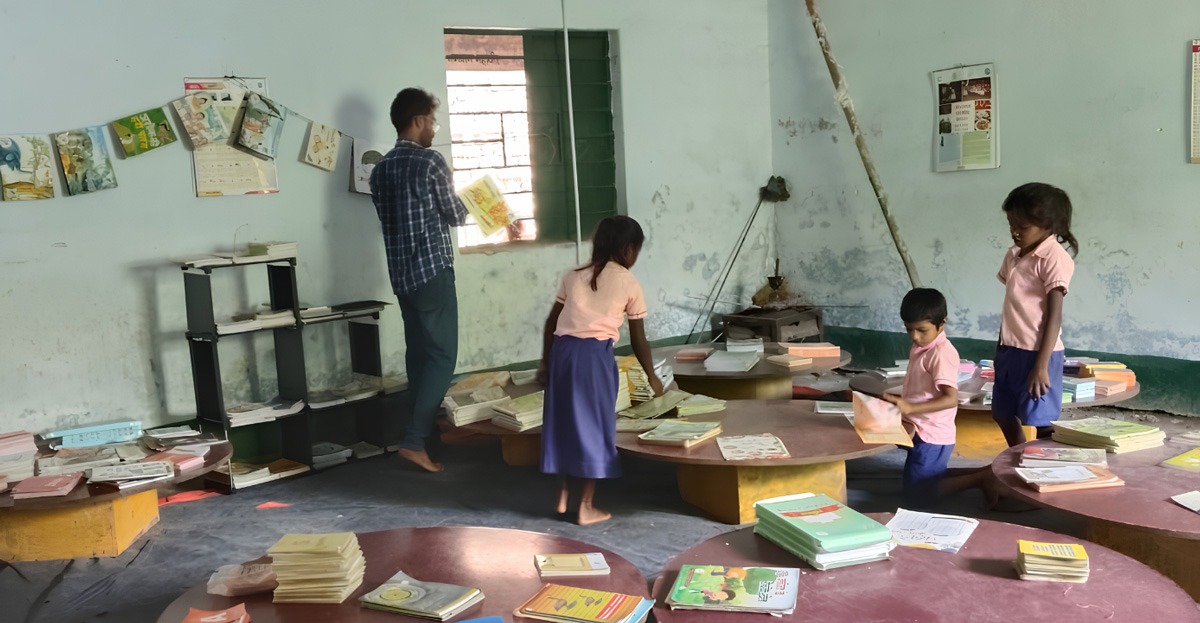
Today, that library is no longer a closed cupboard. It’s a joyful corner of learning for 63 students. Every day, children visit the library, pick up books, sit together to read and share stories. The younger ones enjoy picture books while older students explore storybooks and often help their friends read. A Bal Sansad (student council) member, designated as the Education Minister, oversees it and maintains the library register. There’s a dedicated period for the library every day.
Standing there, hearing this transformation, I realised I was witnessing something beyond policy implementation.
How Change Actually Happens
I’ve visited many schools where reforms are announced, and resources are provided, yet nothing really changes on the ground. Instructions flow downward, teachers comply (or don’t), and the gap between intention and reality remains wide.
However, this felt different.
The district hadn’t mandated exactly how libraries should look or operate – they had provided guidelines and training, then trusted schools to adapt. CRPs hadn’t delivered instructions – they’d observed, supported, and carried learning across schools. Teachers hadn’t followed protocols – they’d found creative solutions within their constraints. Like Sanjeev, converting an empty classroom into something meaningful. Like the Headmistress at Jhagru Chowki, promising bookshelves and making it happen. And crucially, parents and communities hadn’t just received services – they’d become active participants. Opening almirahs, cleaning books, contributing funds, organising shelves.
No single actor could have created these vibrant libraries alone. The district couldn’t have mandated enthusiasm or creativity. Teachers couldn’t have sustained change without support structures. CRPs couldn’t have spread practices without spaces for reflection. And parents couldn’t have contributed without a genuine invitation.
What I witnessed was different actors playing an active role – observing what was happening on the ground, adapting to local realities, connecting resources and ideas across levels, enabling others to act rather than dictating their every move.
Prajayatna has played a key role over the past two years as a Shikshagraha partner in Lohardaga and Sahebganj, driving system-led change by working with the District Education Office to identify issues, co-design solutions, and build capacity across officials, teachers, and local functionaries. They also partner with the Women and Child Development Department to strengthen Anganwadi and preschool systems, ensuring children are school-ready. This sustained engagement creates conditions for organic, responsive change where system orchestration emerges through multiple actors working in complementary, adaptive ways, rather than through top-down control.
What I’m Taking Away
On my last evening in Sahibganj, I thought about Sanjeev’s register, carefully tracking each book borrowed. About the old almirah at Jhagru Chowki, finally opened after years. About children carrying books home for the weekend and returning with stories to share.
The books are off the shelves now. The students are reading, learning and probably imagining the world in their own vibrant ways.
But what’s also changed is the understanding that emerged from watching this unfold: system orchestration isn’t one person conducting. It’s different actors working in ways that make things work – observing, adapting, connecting, enabling.
When we stop looking for the conductor and start seeing the orchestra, we might finally understand how change actually happens in complex systems like education.
And we can together work towards creating the conditions for it to happen more often.
The initiative is a collaborative effort between Samaaj, Sarkaar, and Bazaar actors. The Government of Jharkhand, the CSR Contributor Axis Bank, the District Implementation Partner Prajayatna and the Program Partner Mantra4Change.
About the Author
Vimal P Thomas 
Vimal works with the Systemic Leadership Collective under the Shikshagraha movement, supporting district-level education programmes aimed at strengthening public education systems and enabling quality education for all children. Previously, he has worked with government systems in Puducherry and Assam as part of the NIPUN Bharat (FLN) mission and has contributed to developing learning resources and teacher capacity-building initiatives. Vimal holds a Master’s in Teaching English as a Second Language (TESL) from the English and Foreign Languages University, Hyderabad.
About the Contributor
Ankit Aman
Ankit Aman is from Jharkhand and works in the field of education with Prajayatna. He completed his MA in Education from Azim Premji University and has been supporting government schools through activities related to foundational learning, joyful classrooms, and community participation. He works closely with teachers and schools to create child-friendly learning environments and encourage meaningful learning experiences for children.