
Think Exponential = Think Speed + Think Scale + Think Sustain.
— Centre for Exponential Change (C4EC)
In a world where problems are complex and interconnected, change can’t be manufactured in silos. It needs to be grown — like a forest. Every tree rooted in its own soil, yet connected underground through shared nutrients, water system and rhythm. Above the ground, each actor has agency, but the change only becomes visible when their actions intertwine, when they start acting together.
That’s exactly what Societal Thinking is all about. It’s not just a theory — it’s a practice of enabling collective action at scale. It helps create systems that are inclusive, adaptive, and self-sustaining — where many actors can solve many problems in many ways.
What is Shikshagraha?
Shikshagraha is a people-powered movement to improve all 1 million public schools in India through micro-improvements — small, context-based actions that collectively lead to large-scale change — so that every child is ready for the future. We believe real change begins with those closest to the child — teachers, parents, school leaders, youth, and local communities. Collectively, we want to reimagine what public schools can and must deliver.
To achieve this, instead of imposing solutions from above, Shikshagraha creates the conditions for change to emerge from within — from the school in a small village, to the education department in the state capital. What makes Shikshagraha powerful is that it is built on the Societal Thinking model. Societal thinking is a way to re-imagine and realise exponential change. Change that inspires more and rapid change.
1. Shared Capabilities
“Set solutions grow. Shared ideas scale.” — Think Scale, C4EC
Think of shared capabilities as the soil of the movement. It’s the public infrastructure that anyone — NGOs, departments, schools — can use, contribute to, or build upon. In Shikshagraha, this includes:
a. Shared Infrastructure
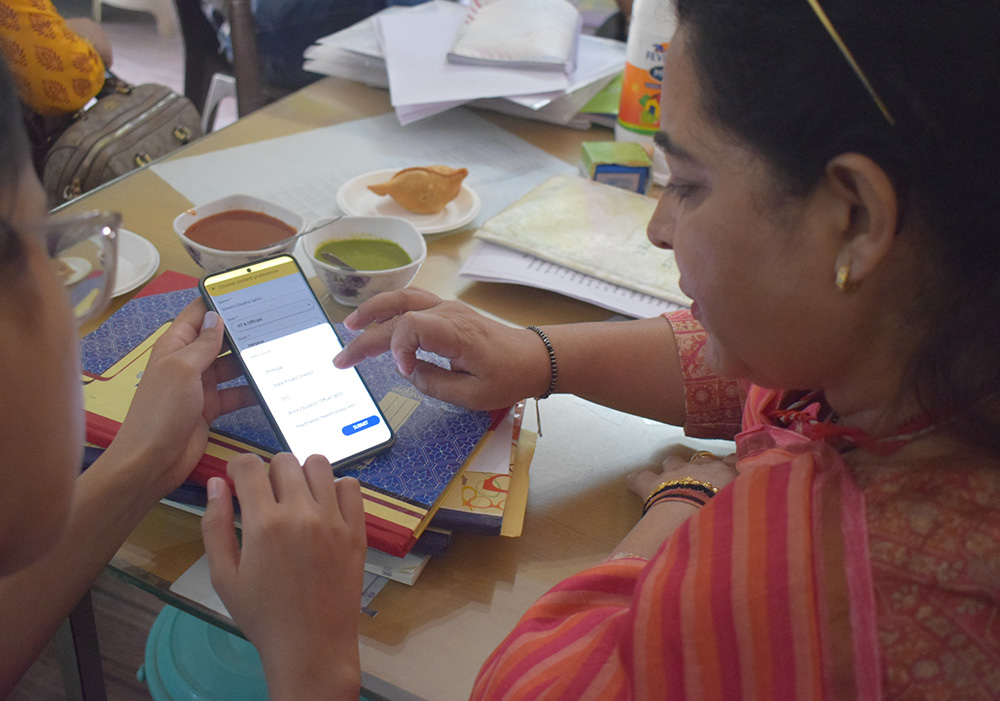
A school leader in Haryana undertaking an enrollment improvement project on DIKSHA
- ELEVATE Building Blocks: An open source repository of powerful capabilities for leadership development. It can be adopted and contributed by anyone within or outside the education sector.
- ELEVATE building blocks are also powering Digital Public Infrastructure (DPIs) like DIKSHA, where thousands of school leaders log their micro-improvement journeys — documenting the change they are leading, the steps they’ve taken, often supported by evidence in the form of photos, videos, and reflections that bring the improvement to life.
- Dashboards give real-time visibility to leaders and others on the progress of the movement.
- Open Knowledge Repositories: Shikshagraha offers shared knowledge spaces where any leader, organisation, or academician can discover, access, adapt, and contribute improvement stories, tools, and templates. These evolving repositories act as a collective resource to learn from and build upon.
- MITRA: MITRA is an AI-powered assistant to help school leaders identify, document and share micro-improvements.
These are public goods—not owned by one actor, but constantly evolving based on field feedback. Like a village well maintained collectively, these tools reduce duplication, lower the cost of innovation, and make it easier for new actors to join the movement.
“Shared infrastructure is what allows speed without friction. When anyone can plug in, build, and improve—it creates exponential momentum.” — Think Speed, C4EC
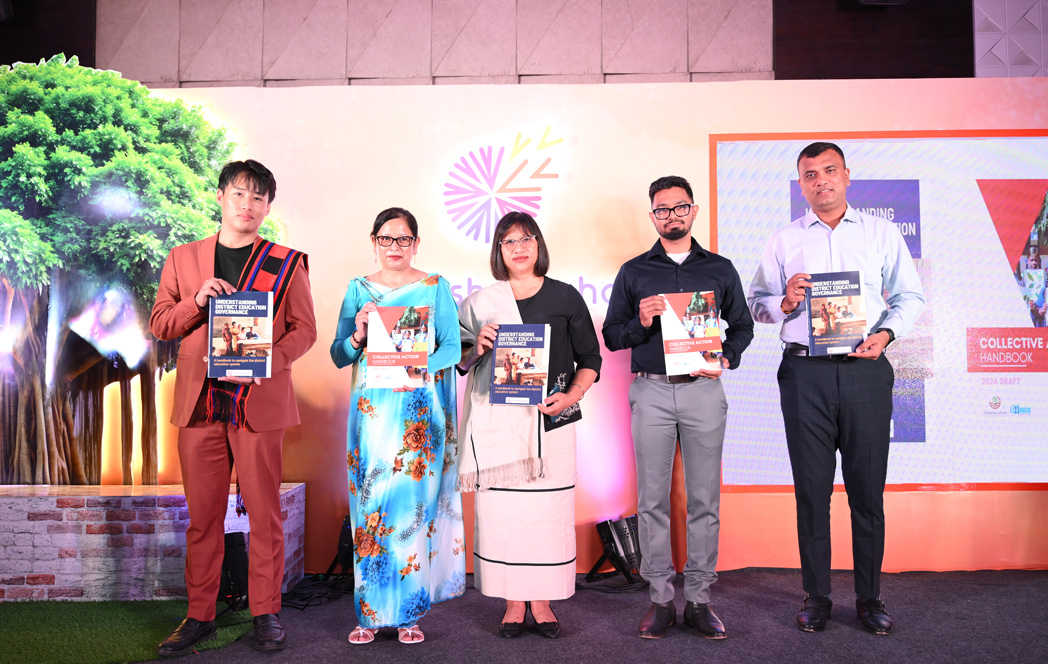
Unveiling of Shikshagraha Assets at Shiksha Samvaad at Guwahati, Assam.
b. Shared Narrative
Creating a common narrative and storyline that everyone—school leaders, NGOs, government partners, academicians—can see themselves in. It aligns diverse actors around a collective purpose, showcases real improvement stories from the ground, and helps the ecosystem communicate a unified message while still honouring local contexts. Shared narrative is strengthening the movement’s identity and reach.
Through Shikshagraha, we are building a shared narrative around four key ideas.
- First, reimagining what public schools can and must deliver. We’re moving them from being seen as the last resort to vibrant centres of learning.
- Second, shifting deep-seated norms that hold education back. This means moving from believing education is solely the school’s responsibility to recognising it as a collective endeavour. It means moving from focusing only on marks to celebrating learning for life.
- Third, centering future readiness. Children need not just literacy and numeracy, but also well-being, confidence, and skills to thrive as entrepreneurs, citizens, and climate-conscious leaders in a rapidly changing world.
- Fourth, amplifying collective action. We bring together Samaaj (communities), Sarkaar (government), Bazaar (markets), and Sanchaar (media). Together, we restore agency to those closest to the child. Together, we make education a public agenda that every citizen demands and every leader prioritises.
This shared narrative is strengthening the movement’s identity and reach. It creates space for new ways of working where schools, communities, and systems move together.
2. Co‑Creation
“The fastest way to go far is to build with others.” — Think Speed, C4EC
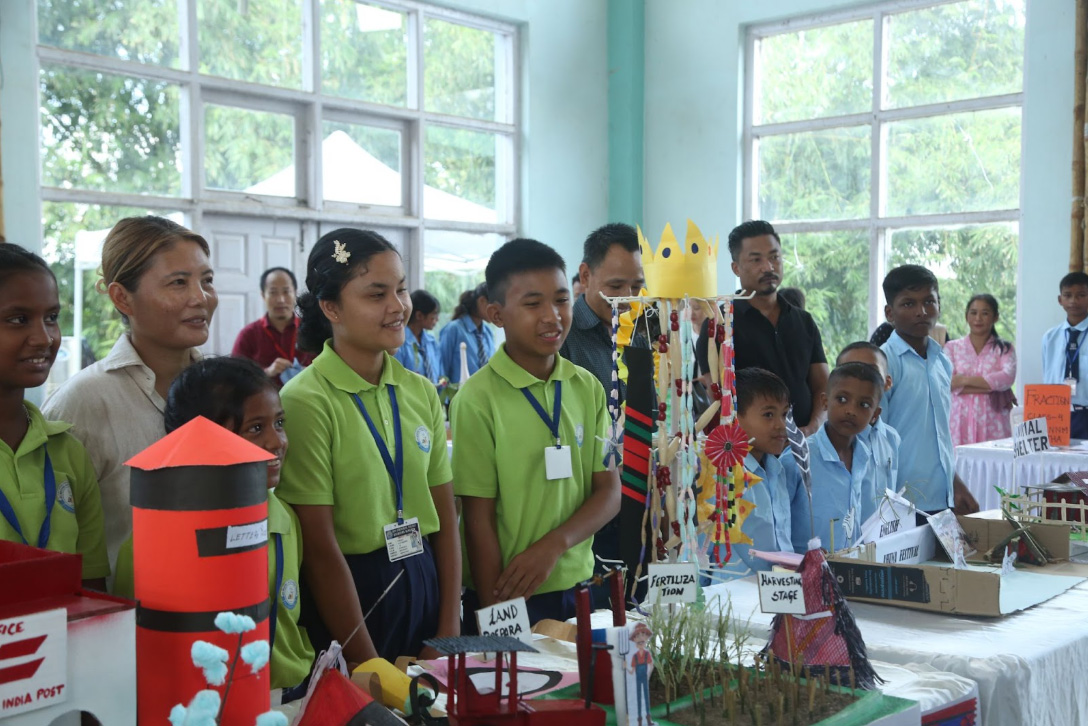
Students showcasing their projects at the Project Based Learning Fair 2025 in Dimapur, Nagaland
If infrastructure is the soil, co‑creation is the act of gardening. It’s where different actors — school leaders, community, NGOs, policymakers, subject matter experts and academicians—come together to co-design, adapt, and iterate solutions relevant to their own contexts.
Shikshagraha places co-creation at the heart of its approach — ensuring that programs and campaigns are not simply delivered to communities, but shaped with them.
Across states like Bihar, Haryana, and Nagaland, respective school education departments and civil society organisations have come together to design contextual micro-improvement programs that respond to the realities of schools on the ground. These initiatives go beyond just strengthening school leadership — they actively aim to improve student learning outcomes, classroom practices, school enrollment, and more.
Some examples include:
- In Bihar, the Project-Based Learning program was co-created by partners like Mantra4Change and Involve, helping students develop problem-solving skills while applying concepts in real-world contexts.
- In Haryana, a STEM education program was designed in partnership with ThinkTac, helping students explore science through hands-on learning and experimentation.
- In Nagaland, localised improvement efforts have involved school leaders, officials, and NGOs working hand-in-hand to design programs that align with their own state priorities. Some examples include the Literacy and Numeracy festival (LNF) that aims to improve foundational literacy and numeracy skills among students.
Importantly, it’s not just state-level programs—districts themselves are designing their own initiatives based on local needs.
- For instance, Lohardaga and Sahibganj districts in Jharkhand have launched an active program on Foundational Literacy and Numeracy (FLN). Co-created by the district education departments and partner NGO Prajayatna, the program focuses on building systemic leadership to implement progressive pedagogy and enhance FLN outcomes across schools.
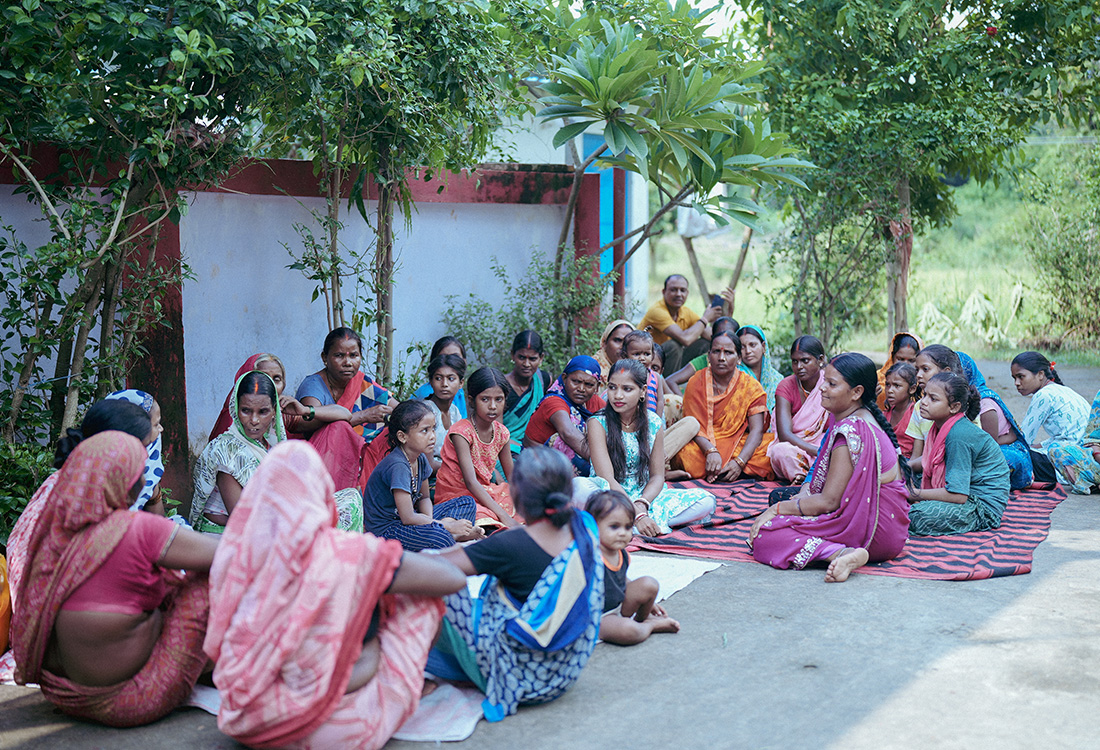
A Shiksha Chaupal in progress at Patna, Bihar
Beyond formal programs, co-creation also happens in community-led spaces:
- Women’s collectives in Bihar and Karnataka are also stepping up. Through Shiksha Chaupal and Chavadi meetings, these groups regularly gather to identify issues in their local schools and co-develop solutions to address them—from infrastructure gaps to teacher accountability.
- In forums like Shiksha Samwad, NGOs, policymakers, subject matter experts, and academicians come together to discuss local challenges, design responses collaboratively, and share them across the ecosystem so others can adopt or adapt them.
Whether it’s a government department, an NGO, a district official, or a group of women in a village — Shikshagraha enables them all to sit at the same table, shaping solutions that are relevant, inclusive, and locally owned.
“Speed in societal change is not about faster delivery. It’s about parallel co-creation. Many building many things, learning fast, and adapting together.” — Think Speed, C4EC
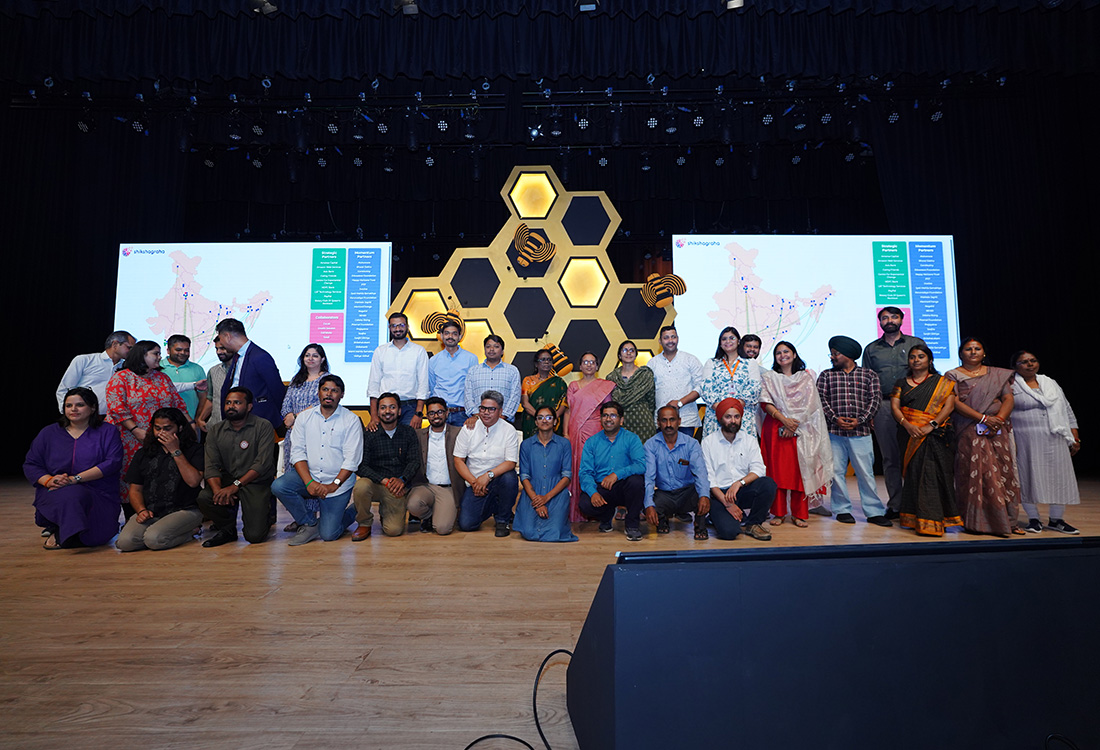
The growing Shikshagraha Network. Picture from InvokED 4.0 in Bengaluru, Karnataka.
“To sustain change, it must become natural to spread.” — Think Sustain, C4EC
As co-creation deepens, a beautiful thing happens: ideas, energy, and stories begin to move through the system. This is the third layer — where Shikshagraha catalyses interactions between Samaaj (civil society), Sarkaar (government), Bazaar (industry), and Sanchaar (media).
Shikshagraha isn’t just running programs—it’s weaving relationships. By co‑designing and implementing education programmes and campaigns alongside the governments and NGOs, the movement is creating pathways for ideas and energy to flow across the system.
At the same time, the movement is working with self‑help groups and local communities to build programmes and campaigns rooted in their own contexts. This ensures that change is not only large‑scale but also deeply local, shaped by the people who live it every day.
This cross‑pollination — between government and grassroots, between statewide platforms and village‑level groups — is what turns isolated efforts into network effects. Good ideas don’t just stay where they begin; they travel, adapt, and multiply across the ecosystem.
Scale in Shikshagraha happens not through mandates, but through curiosity and relevance. When leaders see something working elsewhere, they often adapt it to their own context—not because they’re told to, but because it resonates.
“In a forest, no single tree grows tall alone. It grows because it is in a relationship with others.” — Think Sustain, C4EC
Shikshagraha is a Manifestation of Societal Thinking
- It restores agency: Teachers and leaders are not recipients. They are changemakers.
- It distributes ownership: No one controls the movement. Everyone contributes.
- It adapts continuously: The system listens, learns, and evolves.
- It scales relationally: Through trust, not mandates.
From Blueprint to Forest
We often ask: How do we scale education change across India?
Shikshagraha flips the question: How do we enable every actor to scale their own change—and connect it to others?
In doing so, it becomes not a blueprint, but a forest: rooted, growing, resilient, and alive.
When we say Shikshagraha is a living manifestation of Societal Thinking, we don’t just mean it follows the principles — we mean these principles show up in how people work together, make decisions, and share ownership every day.
“Don’t build big. Build such that many others can build with you.”
— Think Scale, C4EC
About the Author
Aishwarya Rastogi
Aishwarya is the Head – Impact Measurement and Data at ShikshaLokam. She leads the organisation’s efforts to build a data-driven culture that informs strategic decisions and strengthens program effectiveness. She is enabling partners and stakeholders to measure, reflect, and act on program outcomes
Aishwarya is a swimming and dance enthusiast and holds a Master’s Degree in Counselling from the Tata Institute of Social Sciences, Guwahati.